
Guided by Bipin Ajay , Founder of Tech Jitendra .
Java Programming Paradigms
Java programming concept possesses all the advanced programming features that the recent programming languages hold, in addition to these it holds something special which makes it the first of its kind. Following sections are to brief the major characteristics of Java programming.
Object Oriented Programming
Java is an object Oriented Programming (OOP) language. It incorporates almost every OOP features. Object creation through object template i.e. class, data abstraction and encapsulation, data and code sharing through inheritance, overloading concept through polymorphism, and data/process hiding etc. are some basic OOP features in Java, Java is a bit like C++ but more simpler than aristocrat C++. In fact, it is elegant language wherein the poorly understood, erratic, and redundant features of C++ have been eliminated. There are no business of pointers in Java – only lightly bounded heterogeneous collection of data/object. Absence of any kind of pointers means free from huge bugs because pointers manipulation is one of the richest source of bugs in almost all programs. Java is sophisticated enough to help programmers to express complex ideas . Here, global data and stand-alone function are not possible, again, unlike C/C++. The basic programming components in Java is objects which directly or indirectly decedent from the forefathers of classes. The class definition in Java permits both static and dynamic binding and therefore full reuse of code and data sharing. Java is truly Object Oriented Programming in the sense that many class definition can be inherited dynamically. However, Java does not support multiple inheritance whose semantic and usage has been quite controversial. Type casting or operator overloading is also not allowed in Java.
Platform Independent Programming Environment
The microprocessor that is inside every computer can understand and execute only the machine codes i.e. in terms of 0�s and 1�s. But using high level programming, programmers use source code (English like) and using a translator, code is converted into the machine code relevant to the microprocessor. As the machine codes varies from microprocessor to microprocessor so what we need is that for same source code but for different microprocessor type different translator. Hence, a program (source code) when converted into the machine code for an Intel chip will vary from the version for a Motorola chip, which again will be different from the version for Sun workstation. The same problem exists in case of computers having same microprocessors but different operating systems.
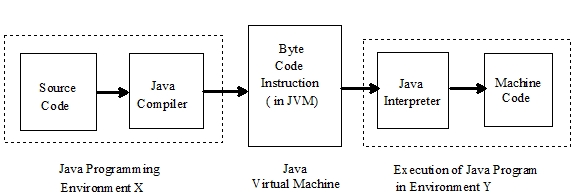
Java has overcome this problem of architecture and environment dependency. Java solves this problem using the concept what is called Java Virtual Machine (JVM). This JVM specifies wonderfully detailed with a dummy CPU and dummy instruction set that looks like standard assembly code. The Java compiler transforms the source programs into the instructions of JVM. The compiled Java code in known as byte code instruction (which are assembly code according to JVM). Next, Java interpreter is there which is specific to each environment (processor and OS) and converts the byte code instructions into the native processor instructions before executing it. Thus, converting a program source into an object code is compile half way and interpret half way. Figure 1.1illustrates this mechanism.
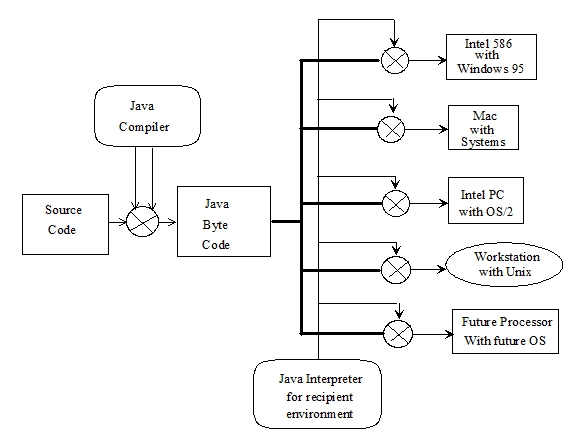
As the Java byte codes are architecture and operating system independent they are highly portable and can be executed on any system without change. This platform independence is illustrated in Figure 1.2
Using the conventional programming languages like C or Pascal, if we need a slice of memory we have to allocate it and then to returns it to the system we are finished with it, Thus, here memory management is solely decided by the programmer. This overhead is eliminated in Java. Here, a program does not need to be malicious to suck up memory and not release it. Java controls all of the memory, Java�s run time system supports automatic garbage collectors based memory management system. Every once in a while, it will scan through all of the objects in a process to see if any of them are not used. The obsolete objects are reclaimed from the memory. As there no explicit memory manipulation is required by the programmer, so Java programs are highly robust
Multithreading
Another important contribution of Java is the support of multithreading. The multithreading is basically, the ability to run several tasks within the context of one large application. In more simpler version, a program is a list of instructions , and path through list of instructions is often called the thread of execution. In many cases, execution of a program through multiple threads makes more sense. For an example, suppose, a program needs to open a file, draw some thing on the screen, and print out something else. Each of these may require waiting for access to some resource. A multithreaded program can, in effect, start up three different threads of executions for these tasks. If the printing thread is waiting for more paper to be loaded in the printer, then the file thread and drawing thread can continue operating. In Java multithreading interpreter can keep track of all threads and switch among all of them, giving each a fair share of the processor�s attention. For most applications, multithreading improves interactive performance and real time system development. The multithreading encourages Java to interface and support several features of modern operating systems and network protocols.
Security in Java
Java is based on client /sever technology, After the accomplishment of source code into byte code translation, Java programs are in effect down loaded from host machines and then run on one�s client machine. Since Java programs are down loaded from all over the world, some precautions are needed to prevent malafide pieces of code called computer viruses embedded within the programs, causing problems to the recipient system and spreading it around. This therefore demands that distributed applications have to exhibit the highest level of security concerns. A byte code verifier in the Java interpreter looks at the incoming byte codes and verifies whether the compiled code is strictly language compliant, in case it founds illegal code, the run time system rejects the code and refuses to run it; thus trapping all malafide codes. Once the strict verification is over, the application proceeds to run and by this Java impotents security holes if any.
Thanking you
Tech Jitendra .
 Tech Jitendra